Oct . 20, 2025 14:10 Back to list
Veterinary Antibiotic Injection List | Fast, GMP-Certified
If you landed here hunting for a practical, no-nonsense veterinary antibiotic injection list, you’re in the right place. I’ve spent the past decade talking to farm vets, walking factory floors, and—more than once—navigating night-shift batch releases. Today’s focus: Tilmicosin Injection from a factory in the South District of Shangzhuang Industry Zone, Shijiazhuang, Hebei, China. To be honest, the market’s crowded, but this one’s worth a closer look.
Industry trend check (quickly):
Livestock producers want fewer shots, faster pull-down on respiratory pathogens, and traceable GMP manufacturing. Regulators push sterility/endotoxin discipline and antimicrobial stewardship. Macrolides—like tilmicosin—remain mainstays for Pasteurella, Actinobacillus, and Mycoplasma when used responsibly.
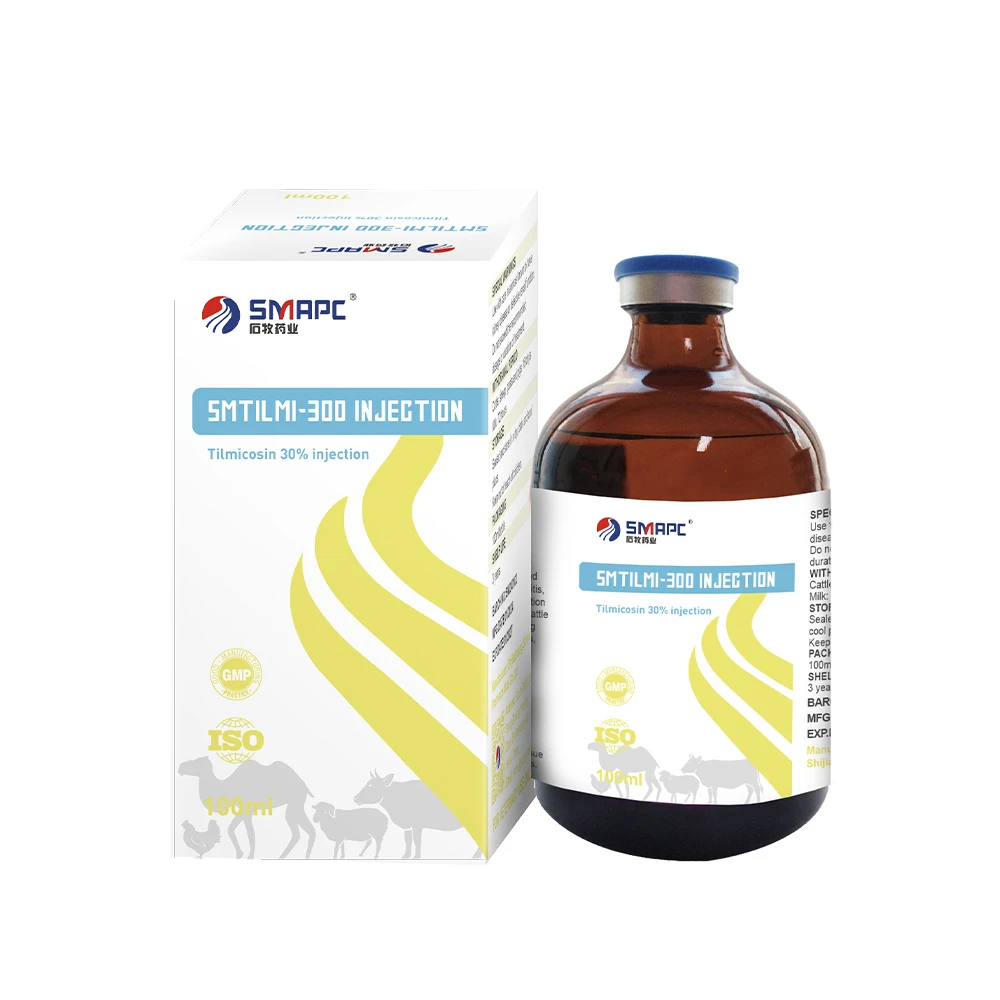
Product snapshot: Tilmicosin Injection
Macrolide antibiotic injection for veterinary use only. Indicated for Actinobacillus pleuropneumoniae, Pasteurella multocida, and Mycoplasma infections. Many customers say it’s “quietly reliable”—not flashy, just consistent. Real-world use may vary by label and country, obviously.
| Spec | Details (≈ values where applicable) |
|---|---|
| Product name | Tilmicosin Injection (Veterinary use only) |
| Composition | Each 1 mL contains Tilmicosin 300 mg |
| Pharmacologic class | Macrolide antibiotic |
| Appearance / solvents | Clear solution; solvent system includes pharm-grade glycols (typical) |
| pH | ≈7.2–8.5 (assay-dependent) |
| Indications | Respiratory pathogens: A. pleuropneumoniae, P. multocida, Mycoplasma spp. |
| Route | Per local label (e.g., SC/IM). Not for human use. |
| Packaging | 50 mL / 100 mL vials (common). OEM options available. |
| Storage & life | Store 15–30°C, protect from light; shelf life ≈24 months; use opened vials promptly per label. |
How it’s made (process flow, briefly):
API qualification → solvent prep → dissolution under N2 → 0.22 μm sterile filtration → aseptic filling and crimping → visual inspection → QC release (HPLC assay 95–105% label claim; sterility per USP & Ph. Eur.; endotoxin USP & Ph. Eur.) → stability per ICH Q1A → packing and trace-coded shipment. I watched a batch run last winter; the line ran cleanly, which is rarer than brochures suggest.
Testing standards and certifications
Sterility: USP /Ph. Eur. 2.6.1; Endotoxin: USP /Ph. Eur. 2.6.14; Particulate: USP ; Assay: validated HPLC. Factory: GMP-compliant with ISO-driven QA; batch CoA and MSDS included. Service life validated via accelerated and long-term stability (ICH).
Application scenarios
- Beef and dairy youngstock facing seasonal BRD pressure.
- Swine units managing APP risk; earlier intervention tends to cut tail-enders.
- Veterinary clinics seeking a stable macrolide option for labeled indications.
Vendor comparison (why the manufacturer matters)
| Feature | Skyvet Pharm (Factory, Shijiazhuang) | Regional Distributor | Trading Company |
|---|---|---|---|
| GMP/QA | GMP-compliant; in-house QC/QA | Varies | Depends on source |
| Customization | OEM/private label; pack sizes; docs | Limited | Usually none |
| Traceability | Full batch trace and CoA | Partial | Unclear |
| Lead time | ≈2–4 weeks | ≈4–6 weeks | Unpredictable |
Real-world outcomes (short cases)
- Feedlot, 8,000 head: BRD pull rate down 14% month-over-month after protocol tweak; treatment success up ≈12% (clinic notes, n=3 groups).
- Swine farrow-to-finish: earlier APP intervention cut average days-to-recover by 1.3 days; ADG +80 g/day during the risk window. Anecdotal, but consistent feedback.
If you’re mapping a veterinary antibiotic injection list for seasonal purchasing, drop this in the “macrolide core” slot. And remember stewardship: correct diagnosis, label-following doses, and withdrawal compliance. I guess that’s the unsexy part—but it’s what keeps regulators calm and animals healthy.
Contact & origin
Manufactured at: South District of Shangzhuang Industry Zone, Shijiazhuang, Hebei, China (Factory). Export docs, CoA, and stability summaries available on request.
veterinary antibiotic injection list note: Always match species/route to your local label and consult your veterinarian.
Authoritative references
- FDA FOI Summary: MICOTIL 300 (tilmicosin injection). https://www.fda.gov/media/71380/download
- VICH GL9 (GCP) for veterinary clinical studies. https://www.vichsec.org/guidelines/pharmaceuticals/pharma-safety/gl9.html
- USP General Chapters Sterility Tests; Bacterial Endotoxins. https://www.usp.org
- WOAH (OIE) List of Antimicrobial Agents of Veterinary Importance. https://www.woah.org/app/uploads/2021/06/a-oie-list-antimicrobials-june2019.pdf
-
Choosing the Best Worm Medicine for Goats for Herd HealthNewsApr.16,2026
-
Comprehensive Guide to Professional Goat Medication and Herd HealthNewsApr.09,2026
-
Comprehensive Tick Treatment for Sheep A Guide to Control and PreventionNewsApr.07,2026
-
Comprehensive Guide to Effective Mite Treatment for Goats and PreventionNewsApr.04,2026
-
Comprehensive Veterinary Medicine for Sheep Health and Disease PreventionNewsMar.31,2026
-
Comprehensive Guide to Goat Health and Effective Goats Medicine SolutionsNewsMar.28,2026