Oct . 24, 2025 15:55 Back to list
Veterinary Injection List: Comprehensive, Updated Dosages
Practical Guide to the Veterinary Injection List: Vitamin E+Se Injection in Real Farm Use
If you manage cattle, sheep, goats—or you’re the vet everyone calls at 2 a.m.—you already know the short, honest version: antioxidant support can make or break performance during stress windows. Today I’m focusing on Vitamin E + Selenium (Se) injections, a small but mighty entry on the Veterinary Injection List that keeps showing up in breeding barns and feedlots for good reasons.
What it is and why farms use it
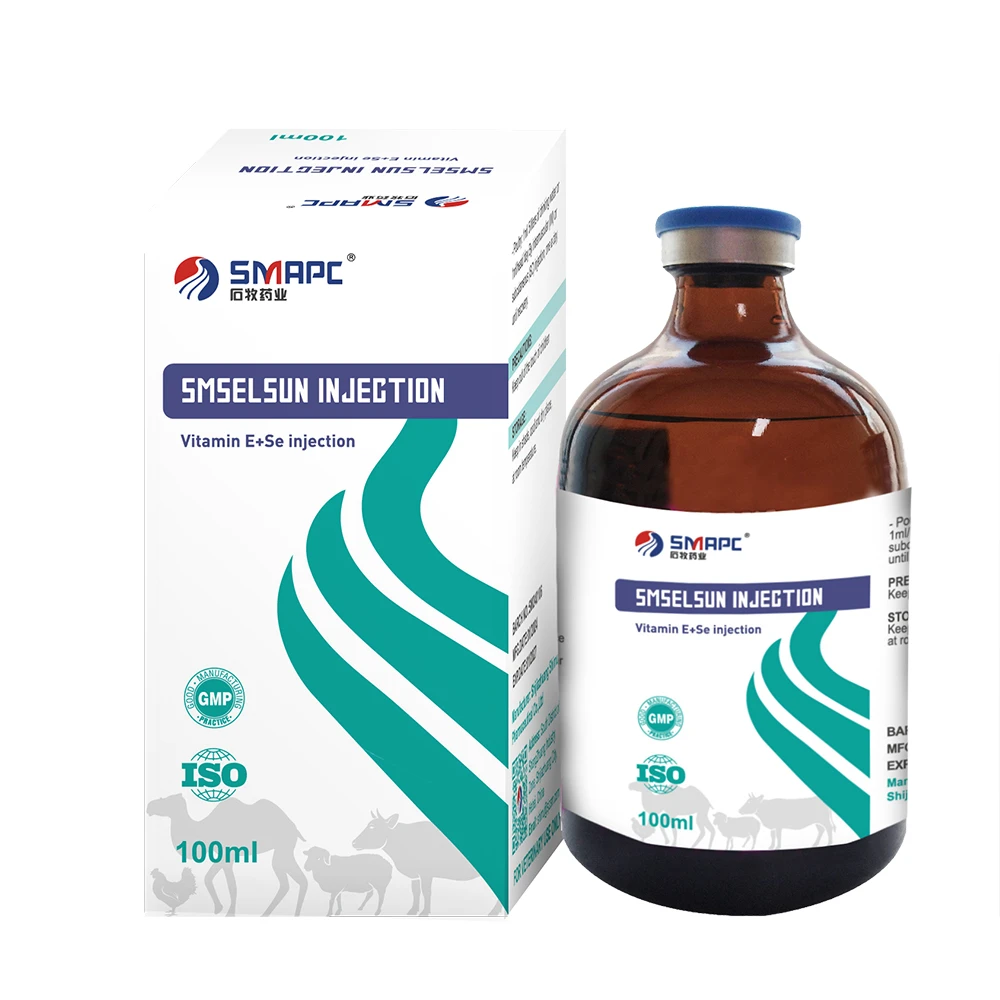
Vitamin E+Se Injection combines an antioxidant (Vitamin E, often as dl-α-tocopheryl acetate) with selenium (commonly as sodium selenite). The duo helps mitigate oxidative stress, supports immunity, and aids muscle integrity—key for preventing white muscle disease in neonates, and for improving reproductive parameters before breeding. Many customers say they notice sturdier calves and better post-transport recovery; to be honest, results vary with nutrition and timing, but the trend is clear.
Snapshot: product specs and dosing
| Parameter | Vitamin E+Se Injection (typical) |
|---|---|
| Composition (per mL) | Vitamin E ≈ 50–100 IU; Selenium ≈ 0.5–1 mg (as sodium selenite) |
| Route | IM or SC (species- and label-dependent) |
| Species | Bovine, Ovine, Caprine, Swine, Equine (check local label) |
| Typical use cases | Pre-breeding, periparturient, neonates at risk of WMD, transport stress |
| Shelf life | ≈ 24 months unopened; in-use (multi-dose) ≈ 28 days; protect from light |
| Packaging | 50/100 mL vials (real-world may vary) |
Manufacturing process flow (how reputable vendors do it)
- Materials: dl-α-tocopheryl acetate, sodium selenite, benzyl alcohol (preservative), propylene glycol, WFI-grade water.
- Methods: controlled dissolution, pH adjustment, 0.22 μm sterile filtration; aseptic fill into depyrogenated vials; light-protective packaging. Some lots also undergo terminal sterilization if compatible.
- Testing standards: sterility (USP ), endotoxins (USP ), particulate (USP ), assay by HPLC/IC, selenium by ICP-MS, stability per ICH Q1A(R2).
- Service life: stress-tested with accelerated (40°C/75% RH) and long-term (25°C/60% RH) stability protocols; real-world farm storage matters more than we admit.
- Industries: dairy/beef operations, small ruminant farms, veterinary hospitals, breeding centers.
Application scenarios and field feedback
We see the best payoff when herds are marginal in selenium (soil-dependent regions) and when neonates are at risk of myopathy. Some vets dose pre-breeding to support conception, others right at calving/lambing. A Nebraska feedlot manager told me—half-joking—that the “E+Se shot is like a seatbelt: you only notice it when you forget it.” Anecdotal, sure, but consistent.
Vendor snapshot (who’s making what)
Skyvet Pharm (factory in South District of Shangzhuang Industry Zone, Shijiazhuang, Hebei, China) is a frequent name on the Veterinary Injection List, competing with regional brands that private-label similar formulas.
| Vendor | Certs | MOQ | Lead time | Customization |
|---|---|---|---|---|
| Skyvet Pharm | GMP, ISO 9001 (docs on request) | ≈ 3,000–5,000 vials | 20–35 days | Label, strength, pack sizes |
| Regional Brand A | ISO 22000 | ≈ 1,000 vials | 14–25 days | Label only |
| Private Label B | GMP (local) | Custom | 30–45 days | Formula + packaging |
Quality, safety, and compliance
- Regulatory: follow national veterinary drug registrations; verify selenium max dose per species (toxicity risk if overused).
- Test data: look for CoA with sterility, endotoxin, assay, and stability summaries. I like seeing ICP-MS for Se—very telling.
- Certifications: GMP and ISO are baseline; some vendors add WHO GMP-style alignment.
- Withdrawal: typically none for milk/meat at labeled doses, but always check local label.
Bottom line: as entries on the Veterinary Injection List go, Vitamin E+Se Injection is a modest cost lever with a surprisingly visible upside—provided dosing respects local selenium status and label directions.
References
- United States Pharmacopeia. USP , , . Current USP–NF.
- ICH Q1A(R2): Stability Testing of New Drug Substances and Products.
- OIE (WOAH) Terrestrial Manual: Veterinary Medicinal Products Quality principles.
- FAO/WHO. Selenium in human and animal nutrition: guidance on safe upper levels.
-
Choosing the Best Worm Medicine for Goats for Herd HealthNewsApr.16,2026
-
Comprehensive Guide to Professional Goat Medication and Herd HealthNewsApr.09,2026
-
Comprehensive Tick Treatment for Sheep A Guide to Control and PreventionNewsApr.07,2026
-
Comprehensive Guide to Effective Mite Treatment for Goats and PreventionNewsApr.04,2026
-
Comprehensive Veterinary Medicine for Sheep Health and Disease PreventionNewsMar.31,2026
-
Comprehensive Guide to Goat Health and Effective Goats Medicine SolutionsNewsMar.28,2026