Oct . 10, 2025 13:00 Back to list
Veterinary Injection List: GMP-Certified, Fast Supply?
A practical insider’s guide to the veterinary injection list
If you’re scanning the veterinary injection list for reliable macrolide options, you’ll inevitably run into Tylosin Tartrate Injection. I’ve walked enough plant floors and buying committees to know: spec sheets tell part of the story; field outcomes tell the rest. Below is the quick, honest rundown—what matters, what to check, and where buyers get tripped up.
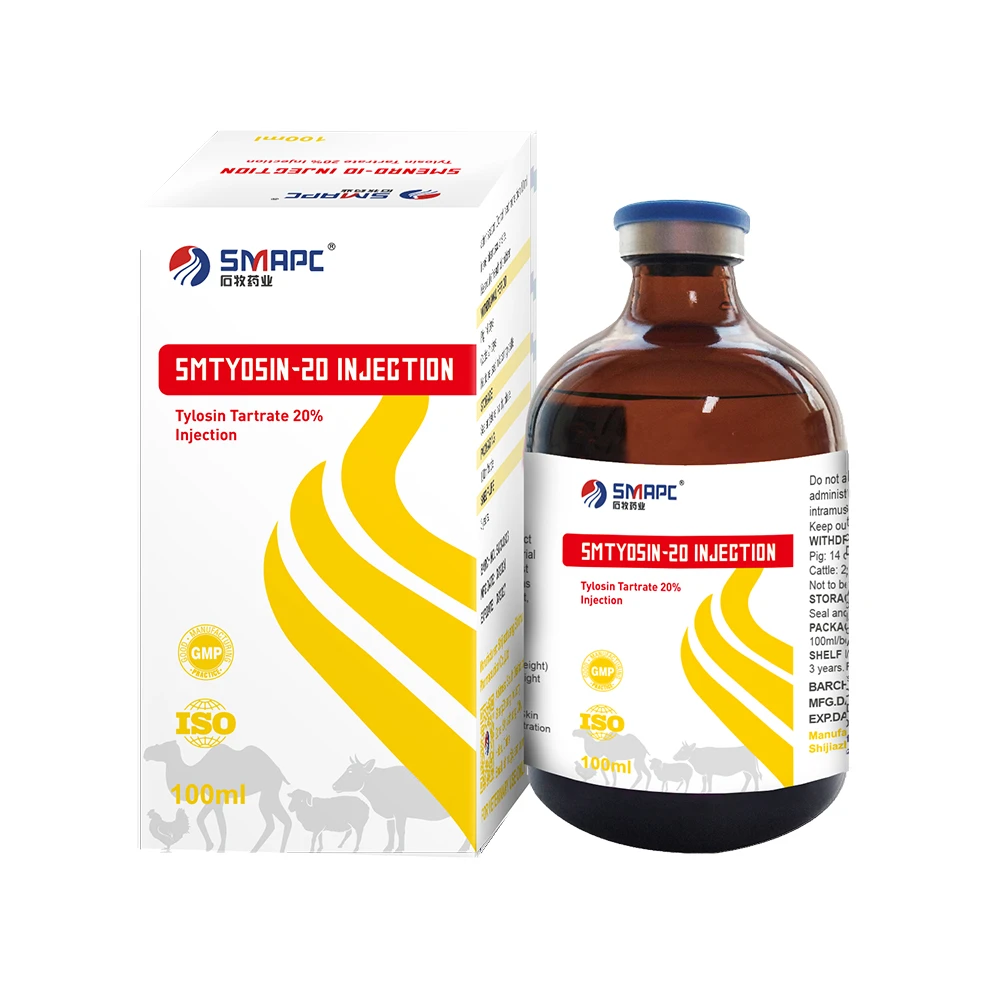
Product snapshot: Tylosin Tartrate 20% Injection
Origin: South District of Shangzhuang Industry Zone, Shijiazhuang, Hebei, China (factory). For veterinary use only. Each ml contains tylosin tartrate equivalent to tylosin 200 mg. Indications routinely include respiratory and genitourinary infections, otitis, cellulitis, and secondary bacterial conditions linked with viral disease or post-operative settings; in pigs: swine dysentery, erysipelas, and enzootic pneumonia; also foul-in-the-foot, mastitis, and calf pneumonia. That’s the formal language. In barns, teams use it when Mycoplasma and Gram-positive suspects are on the table—and time is tight.
Key specifications (buyer-facing)
| Active | Tylosin tartrate ≈ 200 mg/ml (20%) |
| Solvent | Water for Injection, with stabilizers (as applicable) |
| Appearance | Clear to slightly yellow, particulate-free (visual spec) |
| pH (typical) | Around 6.0–8.0 (real-world may vary; see COA) |
| Shelf life | Commonly 24 months sealed; confirm storage on label/COA |
| Packaging | Vial/ampoule sizes vary by market; verify with vendor |
Process flow, methods, and testing
Materials: API tylosin tartrate, Water for Injection, sterile-grade excipients. Methods: dissolution under controlled temperature, pH adjustment, fine filtration (typically ≤0.22 μm), aseptic filling, terminal packaging. QC: ID and assay (HPLC), sterility testing (USP <71>/Ph. Eur. 2.6.1), bacterial endotoxins (USP <85>), particulate matter (USP <788>), pH, appearance, fill volume, and stability studies per ICH Q1A(R2). Service life is tied to validated stability and cold-chain discipline during transit—don’t skip temperature loggers. Industries: swine, poultry, cattle; also mixed large-animal practice.
Application scenarios and advantages
- Mycoplasma-driven respiratory outbreaks where macrolides are frontline.
- Mixed infections post-viral insult; farms like the rapid clinical turnaround.
- Pig units battling dysentery or enzootic pneumonia—with vet oversight.
Advantages: strong activity against Mycoplasma spp., flexible in multi-species operations, and—many buyers note—predictable clarity and low visible particulate rates when sourced from consistent lots. To be honest, local susceptibility patterns still rule; always consult antibiograms.
Vendor comparison (what procurement teams actually check)
| Vendor | GMP/QA posture | Lead time | Docs | Customization |
|---|---|---|---|---|
| Factory in Shijiazhuang (Skyvet Pharma) | In-house QA; GMP alignment claimed; request audits | ≈ 2–4 weeks ex-works (lot availability) | COA, MSDS, Stability summary (on request) | Private label, language packs |
| Regional distributor A | Third-party sourced; mixed QA visibility | Stock-dependent; faster domestically | COA copy; batch history varies | Limited |
| Aggregator B | Paperwork-rich, but fragmented sources | ≈ 4–6 weeks | Full dossier promised; verify authenticity | Case-by-case |
Customization and real-world feedback
Label language sets and carton design tend to be the easy wins. Concentration is standardized at 20% for this line; alternate strengths usually need re-validation. Surprisingly, several buyers told me the decisive factor was after-sales QC support—rapid retest and replacement policies when transport excursions occur.
Quick case: a mid-sized swine producer in Southeast Asia reported shorter outbreak resolution after switching to tighter-lot macrolide sourcing; not magic—just consistent potency and cleaner handling. Results vary, of course.
Safety note: veterinary prescription status depends on your jurisdiction; adhere to withdrawal periods and antimicrobial stewardship. If you’re building your internal veterinary injection list, tag entries with spectrum, storage class, and last field efficacy review—procurement loves that.
Testing standards and references
- USP General Chapter <71> Sterility Tests. United States Pharmacopeia.
- USP General Chapter <85> Bacterial Endotoxins Test. United States Pharmacopeia.
- ICH Q1A(R2): Stability Testing of New Drug Substances and Products.
- VICH GL27: Studies to evaluate the safety of residues of veterinary drugs in human food.
- OIE (WOAH) guidelines on antimicrobial use in animals.
-
Choosing the Best Worm Medicine for Goats for Herd HealthNewsApr.16,2026
-
Comprehensive Guide to Professional Goat Medication and Herd HealthNewsApr.09,2026
-
Comprehensive Tick Treatment for Sheep A Guide to Control and PreventionNewsApr.07,2026
-
Comprehensive Guide to Effective Mite Treatment for Goats and PreventionNewsApr.04,2026
-
Comprehensive Veterinary Medicine for Sheep Health and Disease PreventionNewsMar.31,2026
-
Comprehensive Guide to Goat Health and Effective Goats Medicine SolutionsNewsMar.28,2026