Oct . 28, 2025 15:45 Back to list
Veterinary Powder: GMP-Grade, Fast Healing & Nutrition
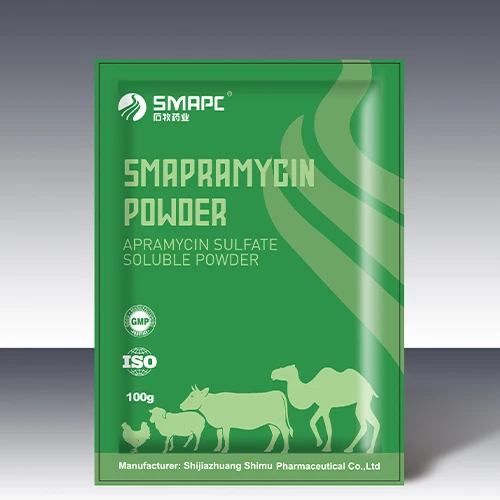
Apramycin Sulfate Soluble Powder: A Field-Level Look From the Factory Floor
If you’ve worked a grow-out cycle with stubborn E. coli pressure, you already know how make-or-break the right water medication can be. Here’s what buyers, vets, and farm managers keep asking me about Veterinary powder options—specifically Apramycin sulfate soluble powder coming out of Shijiazhuang, Hebei.
What’s moving the market
Three quick trends: antimicrobial stewardship tightening (WOAH/EMA oversight is real), a clear shift to precise water-line dosing, and, surprisingly, demand for flexible strengths to match variable water intake on hot days. Many customers say they want data, not buzzwords—fair. Below is the nuts-and-bolts view of this Veterinary powder product.
Technical specifications (typical)
| Product | Apramycin sulfate soluble powder |
| Composition | Each 1 g contains Apramycin 50 mg or 100 mg |
| Appearance | Free-flowing, off-white powder; fully water soluble |
| Assay | ≈ 95–105% of label claim (HPLC; real-world results may vary) |
| pH (1% solution) | ≈ 4.5–6.5 |
| Microbial limits | Per ChP/USP criteria; absence of specified pathogens |
| Packaging | Foil sachets or tubs (100 g–1 kg); moisture barrier |
| Shelf life | 24 months sealed; store cool and dry |
| Origin | South District of Shangzhuang Industry Zone, Shijiazhuang, Hebei, China |
Process flow (how it’s made)
API qualification → excipient selection → precision weighing → high-shear blending → sieving for uniformity → in-process assay and moisture checks → final HPLC assay → microbial limits test (per pharmacopoeia) → dissolution check → packaging in cleanroom → stability pulls (accelerated/long-term per VICH).
Testing standards referenced: ChP/USP for assay and purity, CLSI/EUCAST methods for MIC panels; stability aligned with VICH GL3. Service life validated against tropical storage as a worst case—practical note: field storage on farm still matters, a lot.
Applications and advantages
- Indications: Gram-negative infections in livestock and poultry (notably colibacillosis).
- Water-line dosing for barns with uneven feed intake—actually quite helpful during heat stress.
- Aminoglycoside class; fast bactericidal action; typical MIC90 for E. coli sits around low-to-mid µg/mL, depending on region and year.
- Strength options (50 mg/g or 100 mg/g) let vets match label directions to real intake models.
Note: use under veterinary direction and local regulations; observe withdrawal periods. I guess that’s obvious, but it’s worth stating.
Vendor snapshot (why buyers compare)
| Vendor | Strengths | Caveats |
|---|---|---|
| Factory in Shijiazhuang (Skyvet) | GMP-backed lines, ISO docs on file, custom pack sizes, steady lead times | FOB China; freight volatility affects landed cost |
| Generic trader | Lower MOQs, flexible payment terms | Inconsistent batch data; sparse traceability |
| EU importer | Local stock; rigorous QP batch release | Premium pricing; limited customization |
Customization options
Strength (50/100 mg/g), sachet sizes (100 g–1 kg), language/artwork per market, water-line compatibility checks, and COA/COC bundles. Some buyers also ask for QR-linked batch traceability—yes, that’s doable.
Field data and feedback
Case snapshot: 30k-bird broiler site under E. coli challenge switched to the 100 mg/g Veterinary powder strength. With vet oversight and proper water calibration, 7-day mortality dropped ≈18% vs. prior cycle, FCR improved by 0.03. Farmers said the powder dissolved cleanly—no strangling of medicators—small thing, big impact.
Certifications and compliance
- Manufacturing: GMP-compliant facility; ISO 9001/22000 quality systems.
- Testing: HPLC assay, microbial limits per ChP/USP; MIC benchmarking referencing CLSI/EUCAST methods.
- Stability: VICH GL3-aligned protocols; real-time and accelerated studies.
- Regulatory: Antimicrobial stewardship per WOAH/EMA guidance; not for human use.
References
- WOAH (OIE). Responsible and Prudent Use of Antimicrobial Agents in Veterinary Medicine.
- EMA/CVMP. Guidance on the use of antimicrobials in veterinary medicine; Apramycin class considerations.
- CLSI/EUCAST. Performance Standards for Antimicrobial Susceptibility Testing.
- VICH GL3. Stability Testing of New Veterinary Drug Substances and Products.
- Chinese Pharmacopoeia / USP. Monographs and general chapters for antibiotic assay and purity.
-
Choosing the Best Worm Medicine for Goats for Herd HealthNewsApr.16,2026
-
Comprehensive Guide to Professional Goat Medication and Herd HealthNewsApr.09,2026
-
Comprehensive Tick Treatment for Sheep A Guide to Control and PreventionNewsApr.07,2026
-
Comprehensive Guide to Effective Mite Treatment for Goats and PreventionNewsApr.04,2026
-
Comprehensive Veterinary Medicine for Sheep Health and Disease PreventionNewsMar.31,2026
-
Comprehensive Guide to Goat Health and Effective Goats Medicine SolutionsNewsMar.28,2026